Engagement
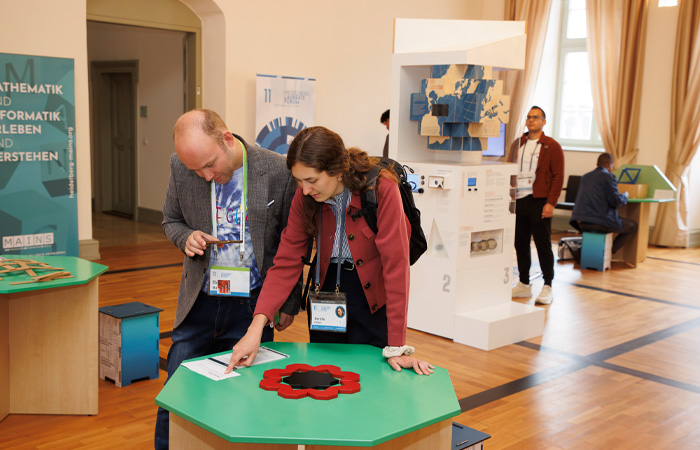
To get people excited about the sciences, the Heidelberg Laureate Forum Foundation (HLFF) engages with local and regional communities. “Experiencing and understanding mathematics and computer science” is the motto of the Mathematics Informatics Station (MAINS), opened by the HLFF in 2017. Various activities for all ages are organized throughout the year to capture the interest of the public in and around Heidelberg: interactive and photo exhibitions, film screenings, lectures, and much more.
The MAINS is a project of the HLFF, which strives to show how exciting mathematics and computer science can be and how important their role is in today’s world. Additionally, each year an exhibition with a mathematics or computer science core runs parallel to the Heidelberg Laureate Forum (HLF) as part of the accompanying program for the public.
Accompanying Program 2026: MAINS on tour
Running parallel to the 13th HLF, the HLFF presented a selection of interactive exhibits from the exhibition “La La Lab – The Mathematics of Music,” created by the open-source-engineers at IMAGINARY. In cooperation with scientists from around the world, IMAGINARY has created a playground for the senses: The inner workings of music are uncovered, and mathematics is able to strike a chord with visitors.
Although almost everyone engages with music in one way or another, most people are unaware of the many connections between mathematics and music. “La La Lab“ invites visitors to explore these connections, experiment with sound and rhythm, and discover the mathematics hidden in almost every kind of music.
Accompanying Program 2026: Public Talk
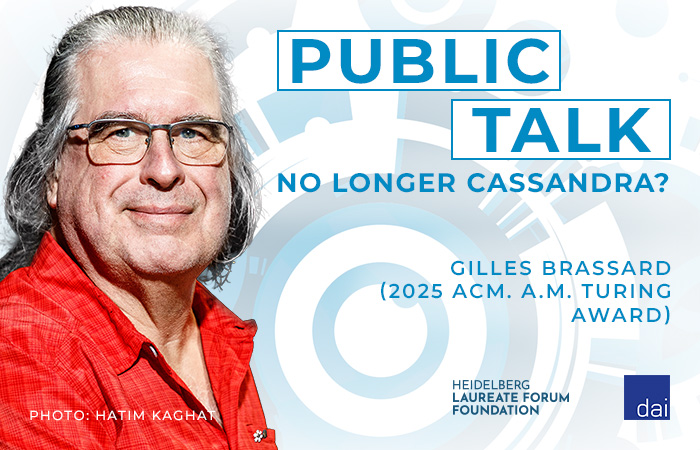
Gilles Brassard (2025 ACM A.M. Turing Award): No longer Cassandra?
Quantum computers promise groundbreaking advances – but they also threaten the cryptographic systems that attempt to protect our digital world. Gilles Brassard explores why today’s security infrastructure must evolve in the face of quantum computing and how quantum cryptography offers a fundamentally different approach to secure communication.
Gilles Brassard, professor at the Université de Montréal, is a pioneer of quantum information science. He co-invented quantum cryptography and quantum teleportation and received the 2025 ACM A.M. Turing Award with Charles H. Bennett.
This event was a joint initiative of the HLFF and the “Deutsch-Amerikanisches Institut Heidelberg” (DAI). It was a satellite event alongside the 13th Heidelberg Laureate Forum (HLF). It is part of a new series of public events through which the HLFF is opening the HLF to the wider public and fostering dialogue between leading scientists and the community.
intercultural science art project (ISAP)
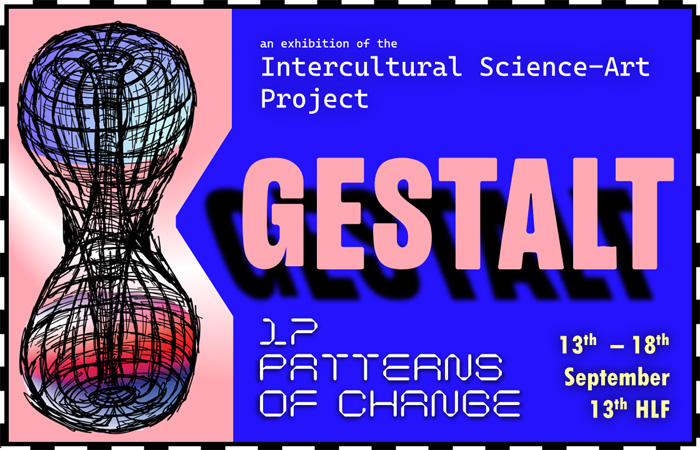
This exhibition hosts artworks created by young researchers attending the HLF. The works are inspired by the artists’ research or scientific interests and are brought to life through the prism of the artists’ own culture. The Intercultural Science Art Project is an initiative created and managed by mathematician, science communicator and HLF alumnus Demian Nahuel Goos, who created it as a meeting point for arts and science. Co-managing the project is Clara Kümpel, an HLF alumna and computer scientist at CISPA Helmholtz Center for Information Security. The project emerged from the HLF, where it was first developed and implemented.
The 2026 exhibition “Gestalt – 17 Patterns of Change” explores the wide variety of changes scientists encounter or help shape throughout their lives. The project can be found online, featuring 17 artworks, along with explanations of the mathematics and computer science behind each piece and brief profiles of the artists.
The 2025 ISAP “Heirs of Infinity” can be found here.